Building a Blueprint for Strategic Business Transformation
- Graham B., Lead Editor at Brian Tracy Publishing

- Aug 25, 2025
- 3 min read

Inspired by Cracking the Business Mastery Code
Introduction: Where Vision Meets Structure
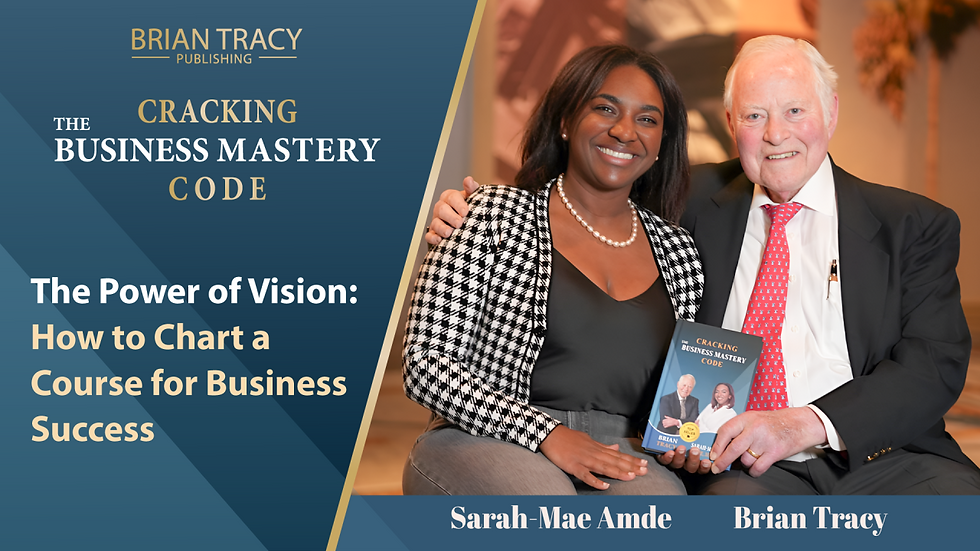
Business transformation is more than momentum — it’s intentional architecture.As Sarah-Mae Amde, MBA explains in Cracking the Business Mastery Code, great ideas alone won’t scale your business — but a well-structured, data-informed, and vision-aligned strategic blueprint will.
In this article, we’ll explore how to translate ambition into execution by designing a blueprint that accelerates growth and withstands change.
The Purpose of a Strategic Blueprint: Leading with Direction
Every business has a vision — but without a roadmap, even the boldest vision can drift off course. Sarah-Mae emphasizes that a strategic blueprint functions as both navigation system and accountability tool.
It brings structure to your goals, clarity to your priorities, and cohesion to your team.
Start with a Strategic AssessmentBefore drafting any new plan, leaders must assess their current operational reality. This includes evaluating financial health, customer feedback, employee capacity, and existing processes.
“You can’t architect change, if you don’t know what’s already holding your structure together — or what’s quietly pulling it apart.” - Sarah Mae
How to Build Your Strategic Blueprint (The Essentials)
According to Sarah-Mae Amde, building a strategic blueprint begins with clarity — not complexity. The most successful business transformations are guided by plans that are both structured and adaptable, grounded in data, and aligned with measurable goals.
The first step is to set clear objectives. This means defining what success looks like in specific, concrete terms. Rather than relying on vague aspirations, Sarah-Mae encourages leaders to break ambitious visions into attainable phases. This not only makes progress feel more achievable, but also gives teams a tangible sense of direction.
Next, it's critical to establish key performance indicators (KPIs) that track progress across multiple areas of the business — whether that's revenue growth, operational efficiency, customer experience, or cultural alignment. KPIs give leaders a measurable way to evaluate whether their blueprint is working, and where adjustments are needed.
A strategic blueprint should also include milestones that are tied to time-based checkpoints. Transformation is rarely linear, but without regular moments of review and reflection, it becomes difficult to measure how far you’ve come — or how close you are to where you want to be. These milestones create shared accountability and momentum.
Finally, Sarah-Mae emphasizes the importance of letting data drive your decisions. While intuition and experience matter, analytics provide the clarity and objectivity needed to test assumptions, reduce bias, and validate direction. Leaders who build their blueprints on real-time insights — not just gut instinct — are better equipped to navigate uncertainty.
Key Takeaway
Data provides truth. It’s your blueprint’s reality check — use it to test your thinking, correct course early, and double down on what’s working.
Align Your Blueprint with Your Vision (And Stay Flexible)
A strong strategic plan must support — not distract from — your ultimate vision. Every initiative, investment, and pivot should trace back to your why.
Sarah-Mae also warns leaders not to confuse rigidity with discipline. Markets shift. Teams change. Your blueprint must evolve with context — without losing its compass.
Key Takeaway
Build a plan that can flex without breaking. Review and refine it regularly to ensure it remains aligned with your evolving business landscape.
Blueprinting for Long-Term Transformation
Creating a blueprint isn’t just about efficiency — it’s about leadership.
Sarah-Mae Amde reminds us that true transformation isn’t a burst of effort — it’s a long-term commitment to purpose, clarity, and aligned execution.
Take an honest look at your current strategy.
Are you building from clarity — or improvising from chaos?
Begin the blueprint today that aligns your business with the future you want to lead.
Looking for more? Get the book.

About the Editor
Graham leads the editing team at Brian Tracy Publishing, with decades of experience in helping Brian Tracy and his co-authors publish great books. As an experienced writer, he works to capture the essence of each author's style and message.
“The most valuable asset you'll ever have is your mind and what you put into it..” - Brian Tracy